

The next number The Machine sends to a recovering John Reese and a concerned Harold Finch: an apartment building’s super. Meanwhile, Detective Joss Carter finds out what the vigilante duo really does, and The Machine flashes back to the first time it sent a number.
Tonight, let me reflect deeply on the 11th episode of Person of Interest (Season 1), “Super.”
Spoiler warning: This post contains major plot spoilers from “Super.” If you haven’t watched it, please do so first before reading my analysis.
Navigation: Introduction, Episode Breakdown, Thoughts & Feelings, Standouts, Conclusion
Episode Breakdown
After Detective Carter helped Finch and an injured Reese escape from CIA agents Mark Snow and Evans, the boss with glasses rushed The Man in the Suit to a coroner’s facility, and he generously paid Dr. Farouk Madani, a former surgeon and pathologist, to stitch him up.
Not long after, Finch booked an apartment for Reese not only to recover for a while, but also to monitor the next number on The Machine’s list…
The Number
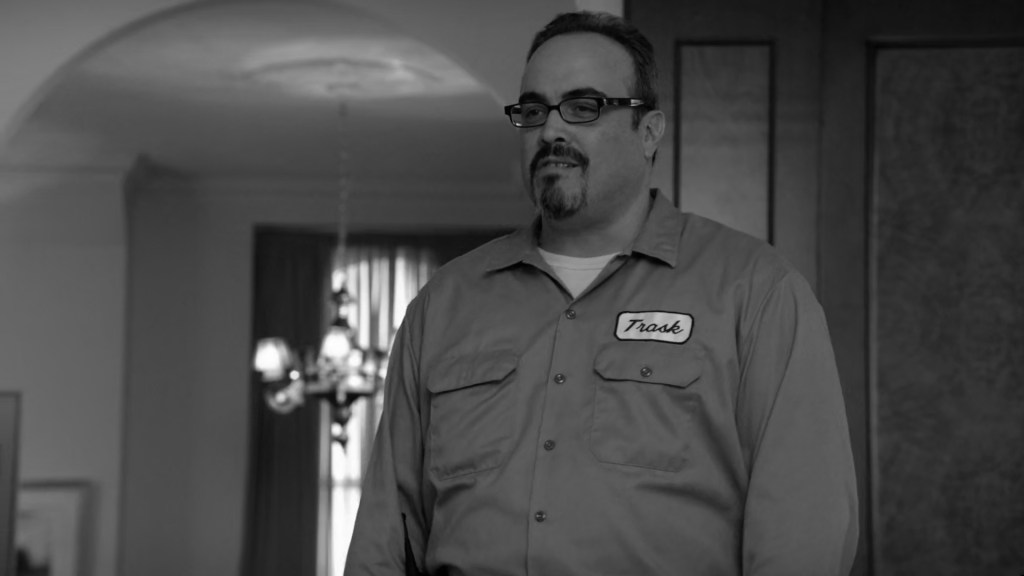
Ernest P. Trask (played by David Zayas), a super of an apartment building who truly cares for his tenants and attends to their needs.
Finch and Reese thought he had a vivid imagination after hearing him say he owned six nightclubs, a yacht, a mansion in Coral Gables, and a pet Bengal tiger when he lived in Miami. But later, it turned out to be true when Finch discovered his true identity: Ernesto Machado, a man who entered witness protection after testifying against the Cuban mafia in 1996. He also had a wife, but she left him after leaving the lavish life behind.
Victim or Perpetrator?
To further investigate Trask (who contacted shops that sell untraceable handguns), Finch and Reese also checked all the tenants’ computer networks and surveillance cameras, and they cut the long list to one potential victim: Lily Thornton, a young bistro chef. When Finch checked Trask’s room, he also found photos of Thornton, and one of them was with a fellow tenant, Rick Morris, a restaurateur who resides at the penthouse and was seen leaving with her earlier.
Later, the duo found out that Thornton has a stalker; she turned down a bouquet of roses, and Finch found a wireless camera hidden in her bedroom vent. They assumed Trask (a super who gardens roses) was the stalker who planned to kill her, and he even warned Morris to stay away from her, with a gun in his pocket. Ernest Trask is the perpetrator. Reese intervened by sounding the building’s fire alarms, which also made the other tenants move out.
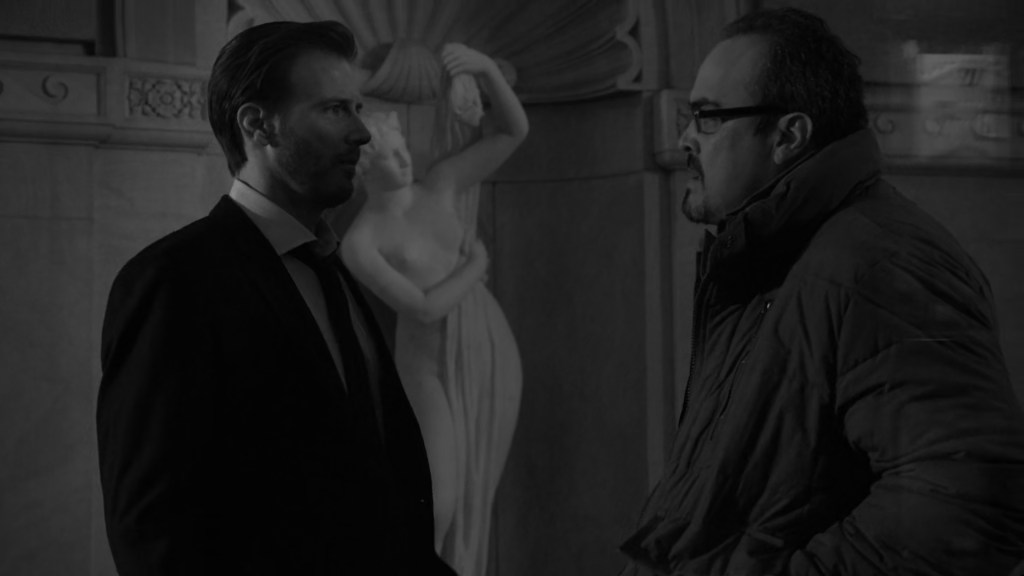
After that, Trask saw Reese inside his own apartment. The man in crutches told the super to leave the building at gunpoint, and even threw the photos of Thornton in front of him. Trask begged and explained that he does care for her, but not romantically. And after decrypting the stalker’s hidden network, Finch discovered that the real stalker was the penthouse owner, Morris. Trask is still the perpetrator, but out of protection for the young chef.
Did They Stop The Crime In Time?
Yes, Reese and Finch stopped Trask from killing Morris, even if he meant to protect Thornton. But more importantly, when a snapped Morris trespassed into the young chef’s apartment, Finch (thanks to the fingerpoke technique Reese taught him earlier), Trask, and Reese (with crutches, no less) stopped Morris from killing the poor woman, with the latter throwing him out of the window.
After an almost-gravely injured Morris was brought to the ambulance, Thornton reported to the police about his obsession and stalking of her, and she thanked Trask, the super, for saving her. On the side, another crime was also stopped: the apartment’s security guard was arrested for theft (which Finch and Reese discovered earlier). With Trask’s weapon disposed of, Finch revealed Reese Trask’s real identity.
Other Threads
The Machine flashed back to 2005, when Alicia Corwin, an official from Washington, met Nathan Ingram and asked for progress on The Machine, and he had the NSA feeds for three years. Ingram gave a piece of paper with nine digits. Corwin asked what the digits were, and Ingram replied, “You work in intelligence. Figure it out.”
To be updated soon.
Navigation: Introduction, Episode Breakdown, Thoughts & Feelings, Standouts, Conclusion
Thoughts & Feelings
The Episode Title
Obviously, the episode title “Super” refers to Ernest Trask’s job as a super (short for superintendent of an apartment building).
There is another meaning of super, and it’s more common. According to Merriam-Webster dictionary, it means “of high grade or quality” and “used as a generalized term of approval.” That can be applied to The Machine’s unbelievably super-accurate delivery of its numbers, relevant or irrelevant. (That’s me overthinking, though.)
On Ernest Trask
Somehow, Trask reminded me of the perpetrator Finch and Reese had to stop from “Cura Te Ipsum,” Dr. Megan Tillman. Both have a reasonable explanation to make the hard call. The caring doctor wanted to murder someone to avenge her sister’s death, while the caring super wanted to murder someone who has been terrorizing one of the tenants. Was it wrong for him to protect Thornton? No. It was actually kind of him to care for her like that, even though that can be read as romantic to some (and he dismissed that to Reese). Was his way of protecting her wrong? For me, yes. As I mentioned in previous reviews, we need to try to be better than evildoers, but I do understand that something must be done to stop powerful, privileged creeps like Rick Morris. Thankfully, Trask and the vigilante duo stopped Morris from coming after Thornton ever again, and it didn’t lead to murder.
I also wonder about Trask’s mafioso past. What made him leave and testify against the mafia? Has he had enough of living that kind of life? Was he threatened to testify? Whatever answers he may have to those questions, it will justify what he said to Reese earlier in the episode, “Had to give all that up. Bad for my health.”
Navigation: Introduction, Episode Breakdown, Thoughts & Feelings, Standouts, Conclusion
Standouts
Finch & Reese’s Temporary Roles
What I love about this episode is that while a recovering Reese is in a wheelchair, the vigilante duo’s individual roles are temporarily switched.
Reese manned the workstation Finch is used to monitoring, and he’s surprisingly good at it. Notably, while tracking all the people connected to Trask (the building’s tenants), Reese discovered that the security guard who was hunting a thief, Douglas Stanley, was the thief after all. When Stanley the thief found Finch after Trask caught him leaving his place, Reese sent the footage to Finch so he could strike a deal: call the police for his thievery or forget he saw him. The stealing guard let him go, but at the end of the episode, he was still arrested by the police. Crime doesn’t pay indeed.
Side note: When Reese finally stood again with crutches, he used those crutches during his fight with Morris! Unbelievable. Creative, efficient, deadly—that’s vintage Reese.
Meanwhile, Finch did the reconnaissance Reese usually does. For starters, Reese gave his hacker boss a bump key to easily enter the rooms. He even taught him some basic self-defense, which he surprisingly used against the stalker Morris to stop him from killing Thornton. For the first time, Finch fought, even for a second! That’s a true standout for me.
“That, Detective Carter, is what we do.”
Not long after Detective Carter helped Finch and Reese escape from CIA agents, she finally met The Man in the Suit’s boss in a restaurant. She wanted to know what they really do, and Finch answered vaguely by giving the first number she must track, Derek Watson. She couldn’t believe that Watson would be involved in a violent crime, but she investigated further, and eventually, she was there just in time to stop Watson from killing his target. After making the arrest, Finch called her, “That, Detective Carter, is what we do.”
Welcome to Team Machine, Detective Joss Carter.
Side note: Carter’s counter-surveillance tactics against CIA agents Mark Snow and Evans are also unbelievable. Notably, not using her own computer to track down Finch is a clever way to redirect the spies’ attention. Nice one, Carter.
“You want me to pop the hood?”
Harold Finch is one paranoid man who doesn’t trust people easily, but at the end of the episode, The Machine showed that its creator is capable of fully trusting someone, and that someone is his friend and co-creator of the system, Nathan Ingram.
When The Machine looked back at Finch and Nathan Ingram’s celebration of their first success with the surveillance system, Ingram asked his friend how the system spotted Gordon Kurzweil as a traitor, and he didn’t hesitate for a second in answering. After Finch popped the hood, Ingram was terrified of the system’s capabilities, and Finch planned to encrypt it so the government would not abuse it (Denton Weeks already tried to tunnel into it several times). Would Finch be able to give Reese that same trust? Maybe. Maybe not.
And then there’s the final scene: The Machine detected a potential threat involving Nathan Ingram himself. Uh-oh. What will happen to Ingram?
Navigation: Introduction, Episode Breakdown, Thoughts & Feelings, Standouts, Conclusion
Conclusion
After the intense ending of “Number Crunch,” in “Super,” Finch and Reese reversed roles temporarily to stop two perpetrators: a super from killing a stalker, and the stalker from killing an innocent woman. Meanwhile, Carter was let in on the duo’s mission, and the lore of The Machine grew when it looked back to its first number, a case officer turned traitor. Overall, the episode was a return to regular programming with a unique challenge and a new member added to the cause, and the story of the show’s most important aspect, The Machine, expanded splendidly.
Rating: 👁️👁️👁️👁️

Navigation: Introduction, Episode Summary, Thoughts & Feelings, Standouts, Conclusion
Header image: Person of Interest: Super (Season 1, Episode 11).
Disclaimer: This is simply an in-depth analysis from a fan. No copyright infringement is intended in any of the show-related media featured in this post.

 The Diary of The Deranged Writer